
Financial Insights & Business Tips from Fraction CFO
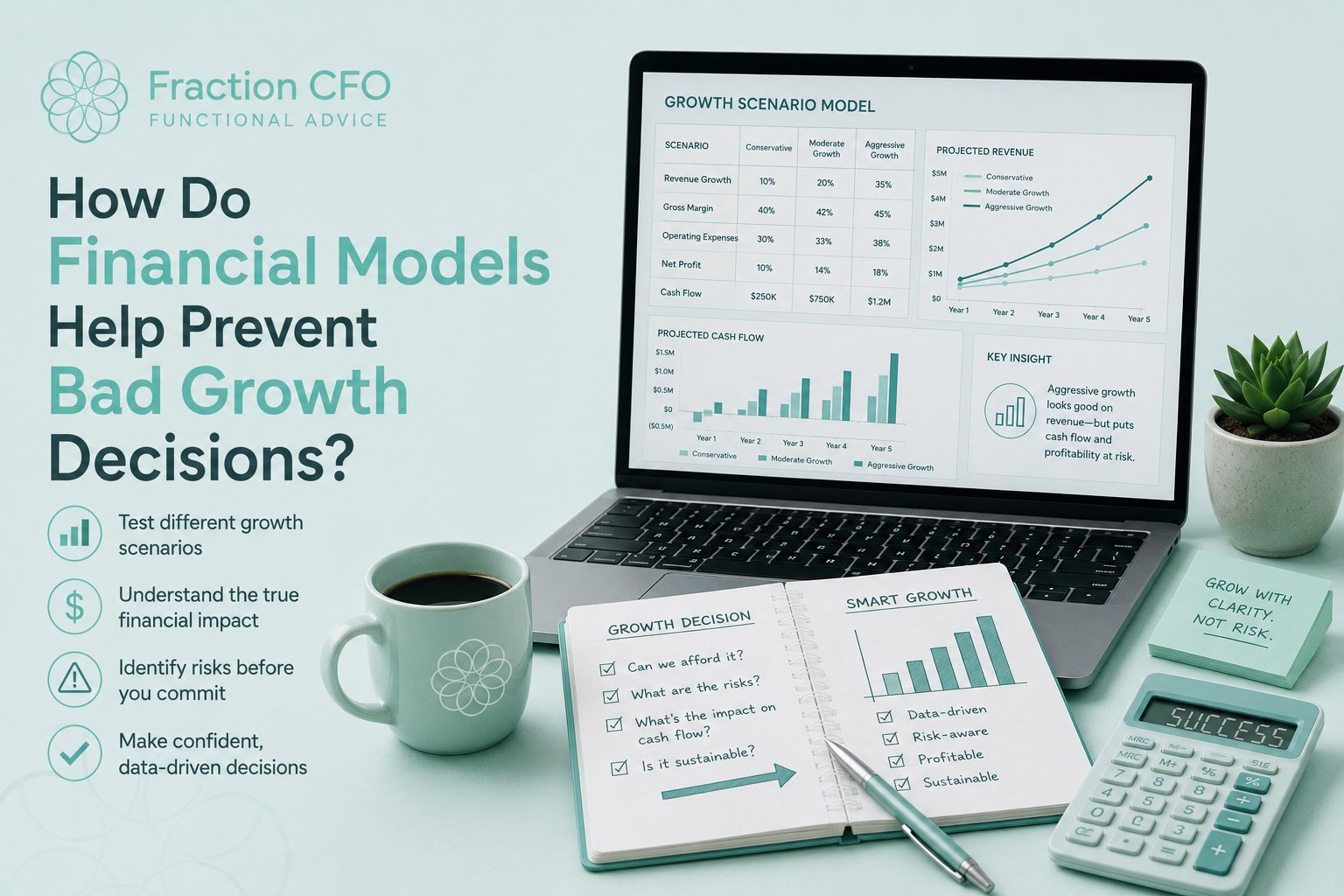
How Do Financial Models Help Prevent Bad Growth Decisions?
Introduction
Growth can create momentum inside a business, but momentum alone does not guarantee sustainable expansion. Many companies increase hiring, expand operations, launch new services, or enter new markets based on optimism without fully understanding the financial pressure those decisions may create later.
The problem is that growth decisions usually involve delayed consequences. Revenue projections may appear strong initially, while the actual operational costs surface months afterward through rising overhead, shrinking margins, or cash flow strain.
Financial models help businesses evaluate those risks before major commitments are made.
A strong financial model is not simply a spreadsheet filled with projections. It is a planning tool that allows leadership teams to test assumptions, evaluate different scenarios, and understand how future decisions may affect profitability, liquidity, and operational stability over time.
Growth Decisions Often Look Safer Than They Really Are
Business expansion rarely feels dangerous in the beginning. Revenue may be increasing, customer demand may appear stable, and leadership may feel pressure to move quickly before opportunities disappear.
Without financial modeling, however, many decisions are based more on confidence than measurable planning.
Common Growth Decisions Businesses Make Quickly
Companies often move forward with:
Hiring expansions
New locations
Product launches
Inventory increases
Marketing scale-ups
Equipment purchases
Software investments
These decisions may all support long-term growth, but they also increase operational obligations simultaneously.
A financial model helps businesses understand whether future cash flow can realistically support those commitments.
Financial Models Create Visibility Into Future Impact
One of the biggest problems with reactive growth is that leadership teams often evaluate decisions individually rather than understanding how they interact together financially.
A financial model connects those decisions into a larger operational picture.
What Financial Models Typically Measure
Most financial models help businesses forecast:
This visibility helps businesses evaluate whether projected growth is operationally realistic instead of emotionally appealing.
Hiring Decisions Become More Strategic
Hiring is one of the most common areas where businesses overextend themselves during growth periods.
Without modeling, leadership may assume future revenue will support payroll increases indefinitely. In reality, hiring often creates long-term financial obligations before revenue fully stabilizes.
What Financial Models Help Clarify
Financial planning can help businesses evaluate:
Whether projected revenue supports additional payroll
How hiring affects future cash flow
When profitability may change
How long onboarding periods may impact margins
Whether hiring pace aligns with operational demand
Instead of reacting to short-term momentum, businesses can evaluate staffing decisions against measurable financial capacity.
Why Timing Matters
Even strong hiring decisions can become financially risky if timing is poor.
A financial model allows leadership to test different scenarios before committing to major payroll expansion. That flexibility often helps businesses avoid sudden hiring freezes or layoffs later.
Expansion Plans Become Easier to Evaluate
Growth opportunities usually come with financial tradeoffs that are not immediately obvious.
Opening a second location, entering a new market, or increasing production capacity may appear profitable on the surface while still creating short-term cash strain operationally.
Financial modeling helps businesses evaluate both the opportunity and the financial pressure attached to it.
Common Expansion Variables Businesses Underestimate
Businesses frequently misjudge:
Ramp-up timelines
Marketing costs
Staffing requirements
Inventory needs
Operating overhead
Working capital requirements
These costs may not become visible until after expansion is already underway.
Scenario Modeling Helps Reduce Risk
One of the most valuable parts of financial modeling is scenario planning.
Businesses can compare:
This process allows leadership teams to evaluate risk before making irreversible commitments.
Financial Models Help Businesses Recognize Margin Pressure Earlier
Revenue growth alone does not always improve profitability.
Some businesses scale rapidly while margins quietly deteriorate because costs increase faster than expected.
Financial models help identify those patterns before they become difficult to reverse.
Areas Where Margins Commonly Shift
During growth periods, businesses may experience:
Higher labor costs
Increased software expenses
Rising customer acquisition costs
Operational inefficiencies
Vendor pricing increases
Without financial modeling, these trends may remain hidden behind rising revenue numbers.
Why Early Visibility Matters
The earlier businesses identify margin pressure, the easier it usually becomes to adjust pricing, spending, hiring, or operational strategy before profitability weakens further.
Strong modeling supports proactive decisions instead of delayed correction.
Investor and Lender Conversations Become Stronger
Businesses seeking outside capital are often expected to explain future growth plans clearly and realistically.
Investors rarely focus only on current performance. They also evaluate whether leadership understands the financial implications of future decisions.
What Investors Usually Want to See
Financial models often help businesses demonstrate:
Revenue assumptions
Hiring strategy
Cash runway
Profitability timelines
Expansion planning
Risk management scenarios
A company without structured forecasting may struggle to explain how growth decisions will affect future operations financially.
Weak Planning Creates Credibility Problems
If projections appear unrealistic or disconnected from operational capacity, investors may question leadership’s ability to manage scaling responsibly.
Strong modeling improves both internal planning and external financial communication.
Financial Models Improve Operational Coordination
Growth decisions affect multiple departments simultaneously. Sales targets influence hiring plans. Marketing budgets affect cash flow. Operational expansion changes staffing needs and overhead structure.
Financial models help leadership teams evaluate these moving parts together instead of independently.
Departments Often Become More Aligned
Forecasting models commonly improve communication between:
Finance teams
Operations managers
Sales departments
Marketing leadership
Executive teams
When everyone works from the same financial assumptions, planning usually becomes more coordinated.
Decision-Making Becomes Less Reactive
Without modeling, businesses often make decisions based on immediate operational pressure.
With stronger forecasting visibility, leadership can:
Prepare for future expenses earlier
Pace growth more sustainably
Evaluate tradeoffs more clearly
Reduce emergency decision-making
This creates more operational stability during expansion periods.
Financial Models Help Businesses Prepare for Slower Growth
One of the biggest forecasting mistakes companies make is assuming strong growth trends will continue indefinitely.
Financial models help businesses test slower-growth scenarios before they happen.
Why Conservative Planning Matters
Even healthy businesses may experience:
Market slowdowns
Seasonal fluctuations
Delayed sales cycles
Rising operating costs
Customer demand changes
Scenario planning helps businesses understand how sensitive operations are to changes in revenue assumptions.
Stress Testing Supports Stability
Businesses often use financial models to evaluate questions like:
What happens if revenue grows slower than expected?
Can payroll still be supported?
How much cash reserve is needed?
Should expansion timelines change?
These exercises help leadership avoid making aggressive decisions based entirely on optimistic projections.
Financial Models Are Most Valuable When Updated Consistently
A financial model loses value when it becomes static.
Business conditions constantly change, which means forecasts need regular adjustment to remain useful.
Strong Financial Planning Is Ongoing
Effective modeling usually involves:
Reviewing assumptions regularly
Updating forecasts with current performance data
Adjusting hiring timelines
Monitoring margin changes
Revising cash flow expectations
This process helps businesses maintain visibility as operations evolve.
Forecasting Is Not About Predicting Perfectly
The purpose of financial modeling is not to guarantee perfect accuracy.
It is to help leadership make more informed decisions by understanding possible outcomes before major financial commitments are made.
Frequently Asked Questions
What is a financial model in business?
A financial model is a forecasting tool used to estimate future revenue, expenses, cash flow, profitability, and operational performance based on business assumptions and financial data.
Why are financial models important for growth planning?
Financial models help businesses evaluate whether future growth decisions are financially sustainable before committing resources to expansion.
Can financial models help with hiring decisions?
Yes. Financial models help businesses estimate how payroll changes may affect cash flow, profitability, and operational stability over time.
What is scenario planning in financial modeling?
Scenario planning involves testing different financial outcomes based on changing assumptions such as slower revenue growth, higher expenses, or delayed expansion.
Do small businesses need financial modeling?
Many small and mid-sized businesses benefit from financial modeling because it improves planning visibility, operational decision-making, and cash flow management.
Conclusion
Financial models help prevent bad growth decisions by giving businesses clearer visibility into how expansion, hiring, spending, and operational changes may affect long-term financial stability. Without forecasting, companies often rely too heavily on optimism or short-term momentum when making expensive commitments.
Strong financial modeling allows leadership teams to test assumptions, evaluate risk, and pace growth more sustainably before financial pressure becomes difficult to manage. The goal is not to eliminate risk entirely, but to improve decision-making through stronger financial visibility and planning.
For businesses looking to strengthen forecasting and long-term financial strategy, firms like Fraction CFO help companies build financial models that support smarter operational growth without requiring a full-time internal CFO team.

© 2025 All Rights Reserved | Fraction CFO
Website Done By: LocalEyes