
Financial Insights & Business Tips from Fraction CFO
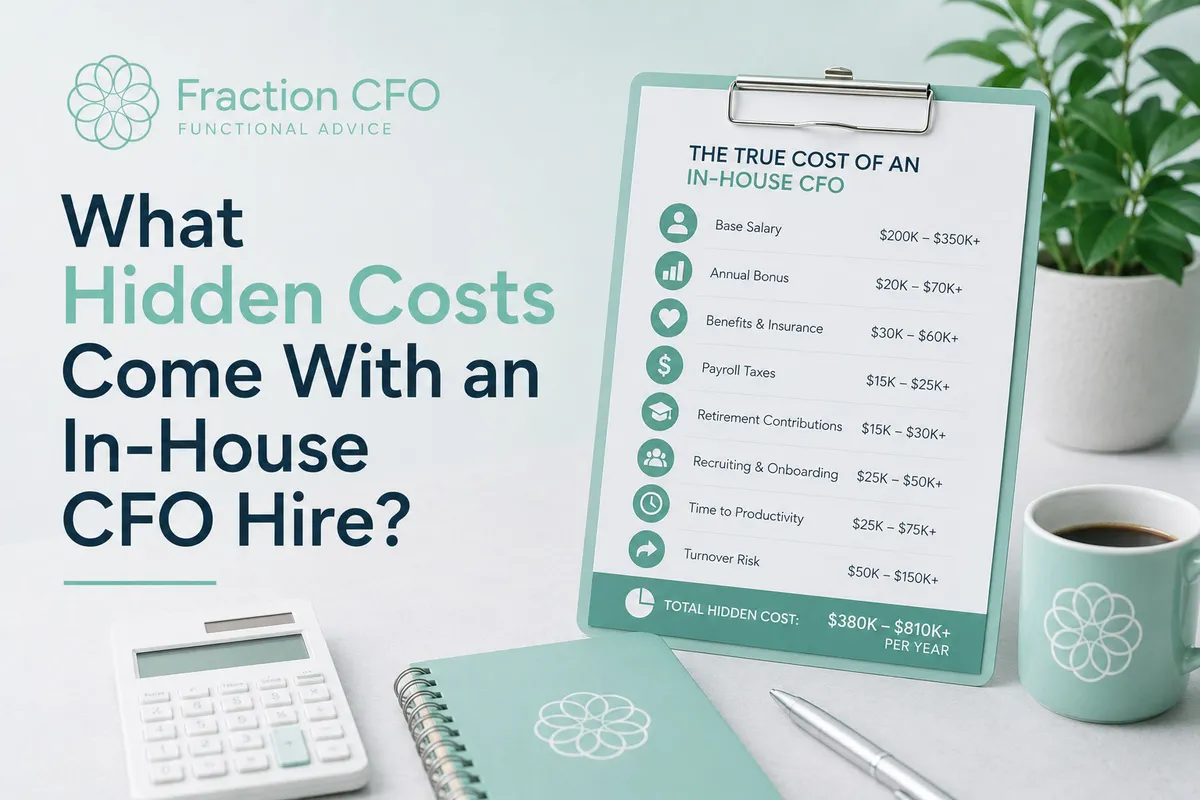
What Hidden Costs Come With an In-House CFO Hire?
The Number on the Offer Letter Is Not the Full Story
The salary on the job posting gets the most attention, but it is rarely the most complete picture of what an in-house CFO actually costs. Business owners in Dallas, Texas, who have gone through the process often discover the real financial weight of the decision only after the budget has already been committed. The costs that do not appear in the initial pro forma are sometimes as large as the ones that do.
This article surfaces those costs so you can make a genuinely informed decision about whether an in-house CFO is right for your business at this stage.
The Visible Costs: What Most Owners Plan For
Before examining what gets missed, it is worth establishing the baseline. Even the most visible compensation costs tend to be underestimated. A CFO in Dallas, Texas, typically earns between $180,000 and $350,000 in base salary depending on industry and experience. Add in the employer-side obligations and the picture grows quickly.
Base Salary and Payroll Taxes
Base salary runs $180,000 to $350,000 annually. Employer-side payroll taxes — Social Security, Medicare, and FUTA — add approximately 7.65 percent, or $13,770 to $26,775 on top of that.
Benefits and Insurance
Health and dental insurance for individual or family coverage typically runs $10,000 to $25,000 annually. Add in disability coverage, life insurance, and any other benefits your company offers and the number climbs further.
Retirement and Bonus
Employer 401(k) match contributions typically run 3 to 6 percent of salary. Performance bonuses at the CFO level are often structured at 20 to 40 percent of base salary, which at the midpoint of the salary range adds $36,000 to $140,000 in variable compensation.
At the high end of this range, visible compensation alone can exceed $500,000 annually before a single hidden cost is factored in.
The Recruiting and Onboarding Costs Most Owners Miss
Finding the right CFO is expensive and time-consuming. Many business owners in Dallas, Texas, focus on what they will pay once the person is in the seat and underestimate significantly what it costs to fill it. The recruiting and onboarding process unfolds in layers, each one carrying its own cost.
Executive search firm fees: Typically 25 to 33 percent of first-year compensation, which for a mid-to-senior CFO hire works out to $45,000 to $115,000.
Internal recruiting time: The CEO, board members, and existing leadership team spend hours reviewing resumes, conducting interviews, and working through the decision process. That time has a real opportunity cost.
Legal and administrative costs: Background checks, reference verification, employment contract review, and onboarding paperwork all add cost that rarely appears in the original budget.
Onboarding ramp: The first sixty to ninety days of a new CFO hire typically produce limited strategic output. You are paying full salary while the person is still learning your business, your systems, and your relationships.
Systems and workspace: Software licensing, system access provisioning, and physical or virtual workspace setup carry costs that are easy to overlook until the invoice arrives.
A realistic recruiting and onboarding process for a senior CFO hire often costs $50,000 to $130,000 before the person has made a single meaningful financial decision for your company.
Equity and Long-Term Compensation: The Cost That Compounds
Many CFO offers include equity as part of the package. For private companies in Dallas, Texas, this is especially common when cash compensation is below market or when you need to attract a high-caliber candidate to a stage that carries perceived risk. Equity grants can take the form of stock options, restricted stock units, or profit interest units depending on your entity structure.
Equity is easy to treat as free money during negotiation because it does not hit your P&L immediately. But it represents real dilution of ownership, real future value exiting through your cap table rather than compounding through yours, and real complexity when the time comes to sell or recapitalize the business.
Even a modest equity grant of one to two percent to a CFO who stays three to five years represents a meaningful cost when your business reaches tens of millions of dollars at exit. That cost is invisible when you make the offer and very visible when you are at the closing table.
The Termination and Replacement Cycle: When Things Do Not Work Out
Executive turnover at the C-suite level is higher than most people expect. When an in-house CFO hire does not work out, you absorb multiple cost layers simultaneously. Each one is worth understanding before you commit to the hire.
Severance
Most executive employment agreements guarantee three to six months of base salary on termination. At the midpoint of the Dallas, Texas market range, that is $67,500 to $175,000 in severance alone.
Recruiting Again
The full recruiting cycle starts over. Executive search fees, internal time, legal review, and onboarding ramp costs are all incurred a second time. Businesses that cycle through two CFO hires in three years often spend more on the search process than on the first year of salary.
Operational Disruption
During the gap between departures and new hires, financial reporting suffers, banking relationships are left unmanaged, and investor communications become inconsistent. The CEO typically absorbs the financial oversight role personally, at the expense of everything else that needs their attention.
Team Morale and Productivity
Finance teams that experience executive turnover often see a dip in morale, output, and confidence that takes months to recover. That loss of productivity has a real cost even if it never appears on a line item.
Frequently Asked Questions
Are there ways to reduce recruiting costs without sacrificing candidate quality?
Some businesses find success recruiting directly through professional networks, which can reduce or eliminate search firm fees. A strong internal HR team and CEO network can substitute for much of what a search firm provides. That said, cutting corners on the vetting process is where expensive mistakes tend to originate.
How does the hidden cost picture change for companies offering mostly equity compensation?
Equity-heavy packages reduce upfront cash burden but the dilution cost is real and often underestimated. Cap table management becomes more complex, and equity granted to a CFO who departs early can create long-term complications. Solid legal and governance structure is essential before any equity-based compensation is issued.
What is the typical notice period for a departing CFO?
Employment agreements usually specify thirty to ninety days of notice, though many departing executives become meaningfully less productive once notice is given. Plan for a real continuity gap regardless of what the contract says. Good financial documentation and clean systems reduce this risk significantly.
Do fractional arrangements eliminate these hidden costs entirely?
Largely yes. With a fractional arrangement there are no executive search fees, no severance obligations, no equity grants, no benefits overhead, and no onboarding ramp. The cost is predictable, scoped, and terminable with appropriate notice rather than a contractual severance obligation.
What financial systems should be in place before making a CFO hire?
Clean historical financials in an organized accounting system, documented month-end close procedures, clear reporting templates, and organized access to banking and lending records all reduce onboarding drag significantly. The better your financial infrastructure before the hire, the faster your new CFO reaches productive output.
Conclusion
The real cost of an in-house CFO hire is substantially higher than the salary figure in the initial budget. For businesses in Dallas, Texas, and across the country, understanding the full picture — from recruiting and onboarding to equity dilution and termination risk — is essential before committing to a full-time hire.
Fraction CFO gives businesses access to the same caliber of financial leadership without the hidden overhead. If you are weighing an in-house hire against a fractional arrangement, reach out for a free consultation and we will walk you through the numbers honestly.

© 2025 All Rights Reserved | Fraction CFO
Website Done By: LocalEyes